eachOFus Register your interest

The home phone, reborn.

A real phone for the whole house, on a private network where a child reaches only the family and friends both homes have approved. No smartphone. No open internet. No strangers. No spam.

Just real conversations with real people they know.

Private, parent approved Zero spam, zero strangers No open internet For families and friends

We are in pilot. Tell us roughly where you are and we will come back to you.
Why eachOFus

There used to be a phone in the hall.

It was how a child first called a friend, how Granny rang to say goodnight, how you let someone know you were running late.

It quietly disappeared with the landline, and nothing safe took its place. A smartphone is the wrong answer for a young child: the open internet, strangers, apps and the endless scroll. So a whole generation of children is growing up without the simple thing the home phone gave the ones before them, a safe way to call the people they love, on their own.

eachOFus puts that phone back in the home, and fixes what went wrong with it. A child reaches only the people both homes approved, and no one else can reach in. The spam, the scams, the robocalls and the wrong numbers simply cannot happen here.

It is the home phone with all of the warmth and none of the noise.

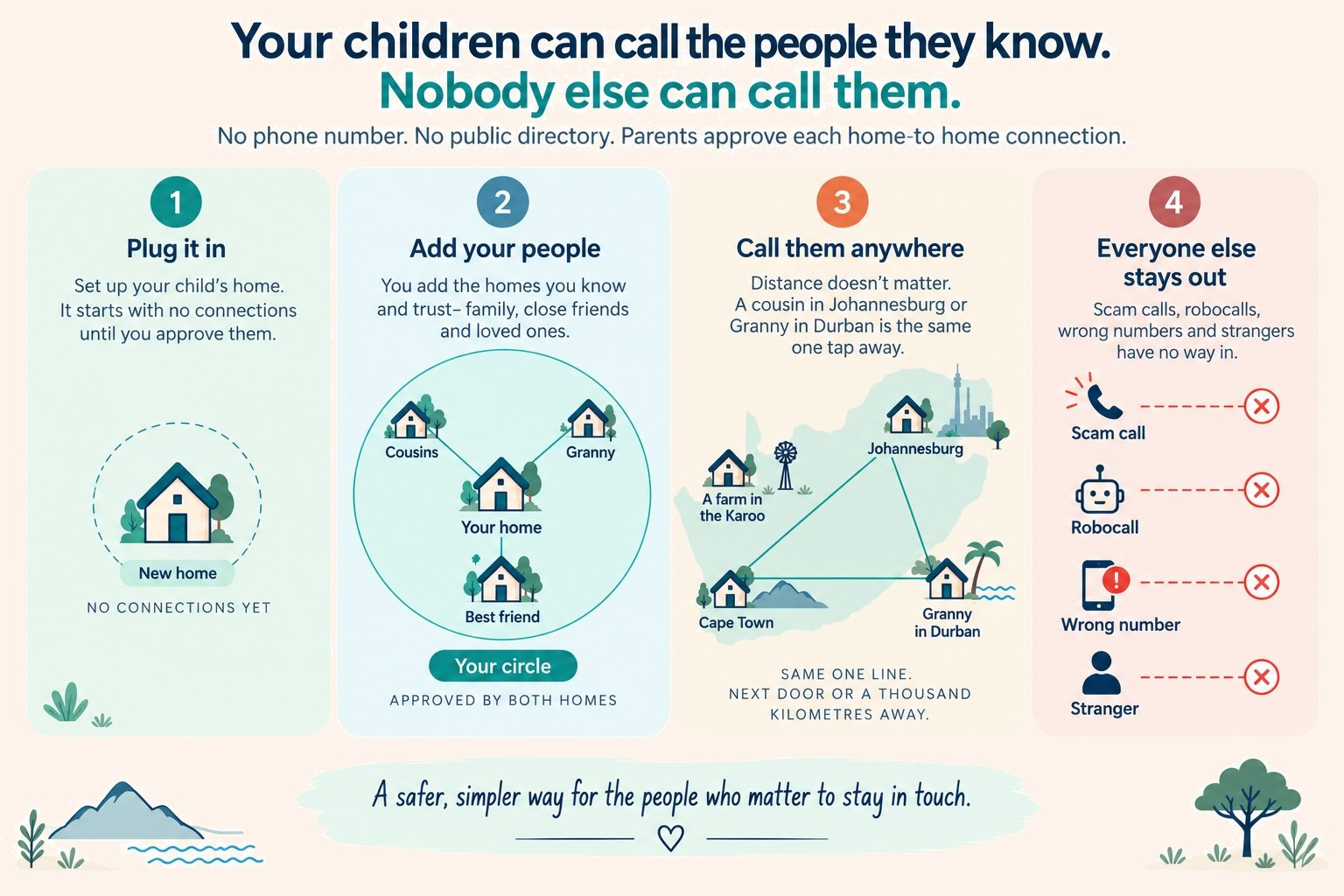
The whole idea, in one picture

A number only your circle can dial.

Every phone has a real number, so a child can learn it and dial it just like any other phone. That number is not on the public network. It is not sold, listed, or reachable from an ordinary phone, so there is nothing for a scam or a wrong number to arrive on.

The private circle Four homes sit inside a ring and are joined to one another. Outside the ring, a scam call, a stranger, a robocall and a wrong number all stop at the edge and cannot get in. Your home Granny Best friend Cousins Scam call Stranger Robocall Wrong number YOUR CIRCLE
Inside the ring, everyone has been approved by both homes. Outside it, there is simply no way in, because there is no public number to dial.
What it is for

The everyday calls a child should be able to make.

Sorting out a play date

A child calls their best friend directly to make a plan. No borrowing a parent's phone, no app, no waiting.

Goodnight from Granny

A grandparent calls their grandchild on a phone they both understand, as easy as the old home phone.

Reaching home when it matters

A parent out of the house rings the home phone to catch the kids before they leave, even if the other parent is busy.

Learning to actually talk

Reading a real number, dialling it, and holding a conversation. The phone etiquette a smartphone never teaches.

A phone that never betrays them

It will never ring with a scam, a stranger or a spam call. On a private network, it simply cannot.

Friends, not followers

A small circle of real people the family knows, not an open feed of everyone and anyone.

How it works

Simple for the family, safe by design.

Plug it in, join the wifi once

No landline needed. From then on it opens a line to a small switchboard the moment it powers up, like a permanent line to an operator.

Parents approve the circle

A friend is added only when both homes say yes. Either home can withdraw it later, at any time.

The child dials a real number

Lift the handset, hear a dial tone, dial the number of an approved friend, and it rings in their house.

What parents see

Who and when. Never what was said.

Parents get an app on their own phone. It is where you agree to a new friend, see who your children have been talking to, and quieten the house at homework time or bedtime.

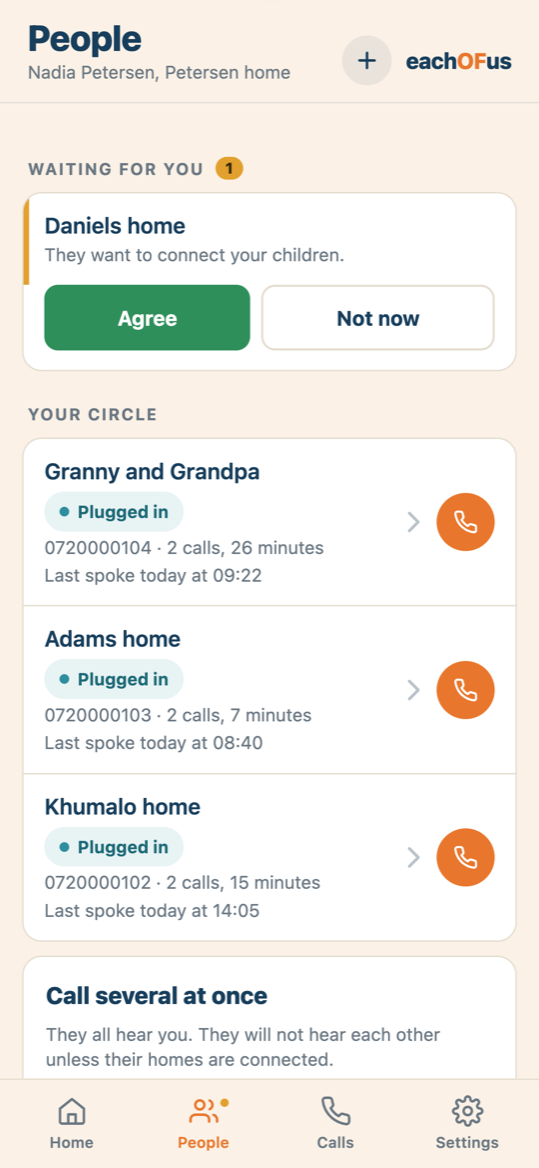
The People screen. A request from Daniels home says they want to connect your children, with an Agree button and a Not now button. Below, the family's circle lists Granny and Grandpa, Adams home and Khumalo home, each marked plugged in.
Both homes agreeNothing connects until a parent at each end says yes.
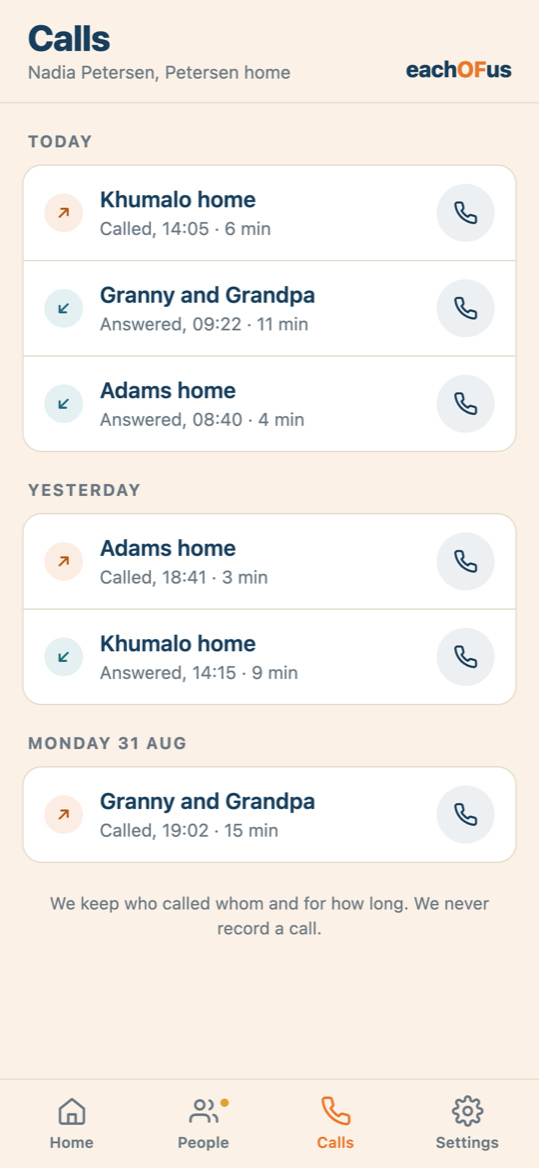
The Calls screen, listing calls by day with who they were with, the time, and how long they lasted. At the bottom it reads: we keep who called whom and for how long, we never record a call.
Who and whenNever a word of what was said. Calls are not recorded.
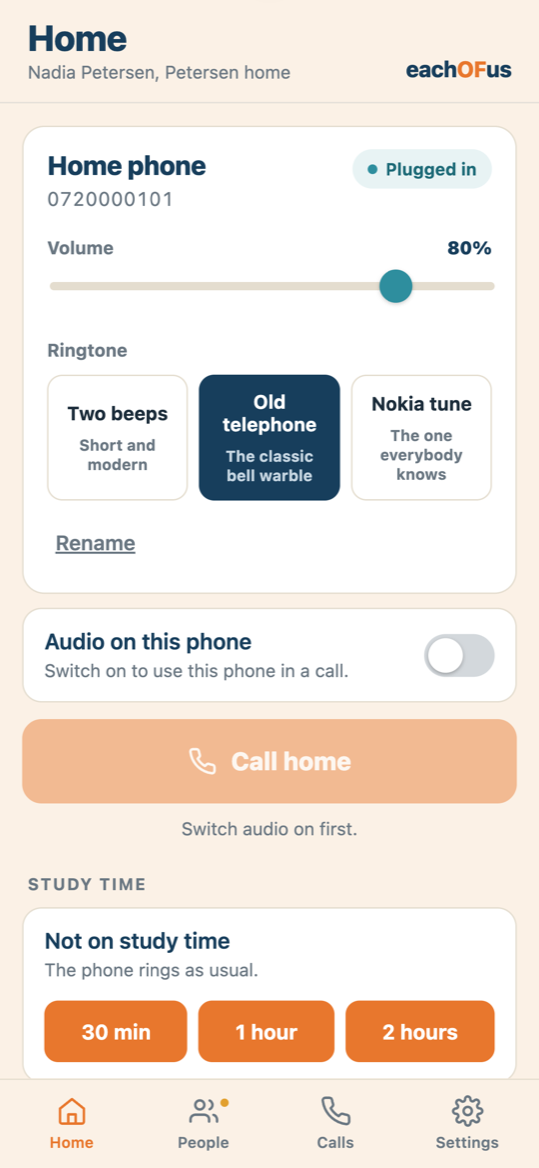
The Home screen, showing the house phone as plugged in, with its number, a volume slider, a choice of ringtone, a Call home button, and study time buttons for thirty minutes, one hour and two hours.
Study time in one tapSilence the house for a while. Callers are told how long is left.
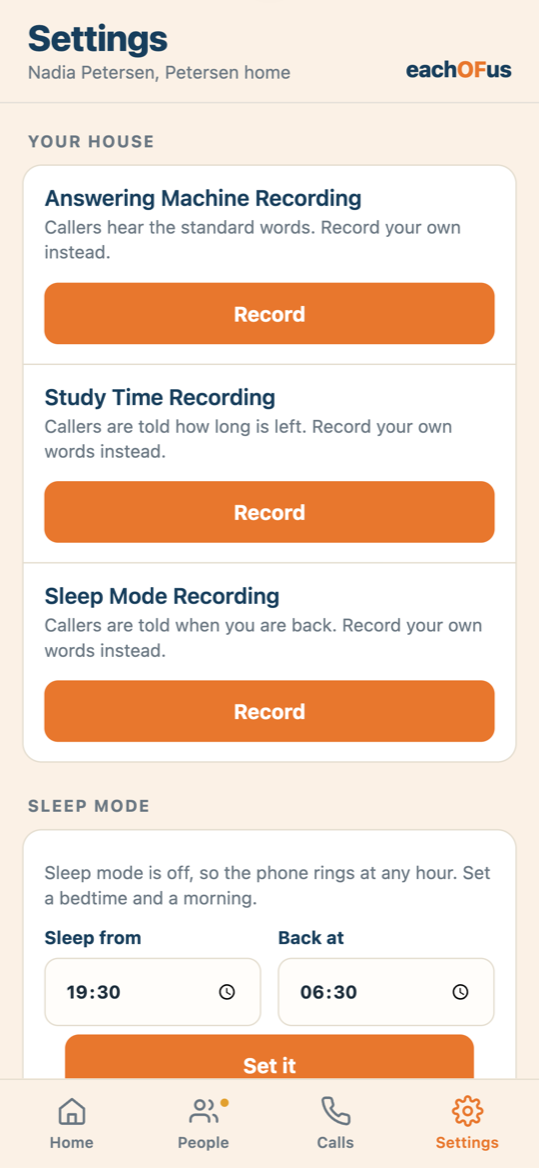
The Settings screen, offering to record your own answering machine, study time and sleep mode greetings, and to set a sleep mode from a bedtime to a morning.
Your house, your rulesA bedtime for the phone, and greetings in your own voice.
  • Calls are never recorded, and never listened to. The system carries the audio and keeps none of it.
  • Parents see who called whom, and for how long. That is the whole of it, and it is enough to know your child's world is healthy.
  • Both homes must agree before two children can call. One home alone cannot open a line into another family.
  • A parent can reach their own home phone, and nothing else. The one bridge in from the outside is deliberately narrow, so the circle stays closed.
  • This is not an emergency phone. It cannot dial 10111, 112, or any emergency number, only the circle you have approved. Keep another way to reach emergency services in the home.

The screens above are the real app, filled with a made up family. No real family's details appear on this page.

Where we are

Built, and in real homes.

This is not a concept. Phones are in houses in Cape Town right now, ringing each other over the internet on the private network described above.

Phones and switchboard working House to house calling Parent app in daily use Pilot group forming Ordering and delivery next
Questions

The things parents ask first.

Can my child be called by a stranger?

No, and not because we filter them out. The phone is not on the public telephone network at all, so it has no number an outsider could dial even if they wanted to. The only phones that can reach it are the ones in homes you and the other parent have both approved.

Does it need the internet, or a landline?

It uses your home wifi, and no landline at all. Plug it in, join the wifi once, and it works from then on. There is no line rental.

It does need your wifi to be on. If your power or internet goes down, so does the phone, which is one of the reasons it must never be your only way to call for help.

Can it call 10111 or an ambulance?

No. It cannot dial emergency services, and we will not pretend otherwise. It reaches only the circle you have approved. Every home needs another way to reach emergency services, and this phone is not it.

Can I call my child from my own cellphone?

Yes. The parent app on your own phone can ring your own home phone, wherever you are. That is the one bridge in from the outside, and it is deliberately narrow: your cellphone reaches your home, and nothing else on the network.

Are the calls recorded?

Never. The switchboard carries the sound and keeps none of it. What is written down is who called whom and for how long, and nothing else. There are no transcripts and no recordings, because they do not exist to be handed over.

Do I have to send you an ID document?

No. Because there is no telephone number involved, RICA does not apply and we never ask for an identity document or proof of address. That is a real difference from anything that connects to the ordinary phone network.

What will it cost?

Far less than a smartphone, and we are building it to be affordable for a household with more than one child rather than a luxury for one. We are settling the exact price with the pilot families first, and we would rather tell you a real number than a hopeful one. Register your interest and we will tell you before you have to decide anything.

How many friends can be on it?

There is no small cap and no monthly bundle of minutes. A circle is meant to be the people a family actually knows: a few friends, the grandparents, the cousins. Calls within it are not metered.